
Beretta 20X Bobcat Holster
Beretta 20X IWB Holster: The Complete Guide to Comfortable and Reliable Concealed Carry Why the Right Beretta 20X Holster Matters


If you’ve ever searched for an IWB holster, you’ve probably discovered there are hundreds of options available. Different materials, clips, ride heights, cant angles, wings, loops, and countless opinions all claiming to be the best. Choosing the Correct IWB Holster is not easy if you need more knowledge. You have come to the right place. We break it down for you. Behind the Hip Carry Holster or Appendix Carry Holster.
The truth is much simpler.
There isn’t one perfect holster for everyone. There is only the holster that fits your firearm, your body, your method of carry, and your daily routine.
Understanding what each feature actually does—and how it works with your body—is the key to carrying comfortably and drawing efficiently.
Whether you’re new to concealed carry or you’ve carried a handgun every day for years, there’s always something new to learn. This guide will walk you through the most important factors to consider when choosing the right Inside the Waistband (IWB) holster.
Before looking at holster features, decide where you intend to carry.
The two most common positions are:
These two positions require different body mechanics, different draw angles, and often different holster adjustments.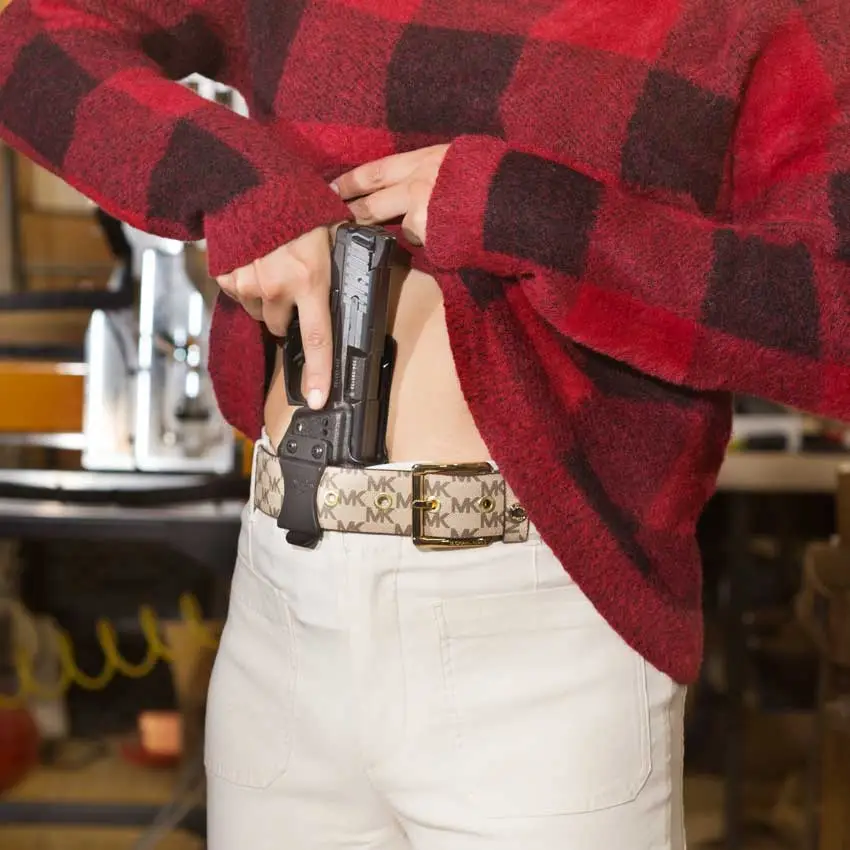
Trying to make one setup work perfectly for both positions usually results in compromises. Instead, configure your holster specifically for how you actually carry.
One of the most overlooked features of any IWB holster is ride height.
Ride height simply refers to how high or low the handgun sits relative to your belt line.
A higher ride height places more of the pistol above your waistband.
A deeper ride height places more of the pistol below your waistband.
Both have advantages.
A higher ride height generally offers:
However, carrying too high can create its own problems.
The pistol may feel less stable during movement, and the grip may print more noticeably under clothing. Choosing the Correct IWB Holster with a little more knowledge will help you in the future. Keep reading.
5 Things to know about IWB Holster
Many people choose deeper concealment because it hides more of the handgun below the waistband.
This can reduce printing, especially with larger pistols.
The tradeoff is accessibility.
If the grip sits too low, your fingers cannot establish a complete firing grip before the pistol leaves the holster. Instead, you’re forced to adjust your grip during the draw—something that costs time and consistency.
There are specialized techniques that experienced shooters can use with deeper ride heights, but they require practice and repetition.
For most concealed carriers, the ideal ride height is one that allows a complete firing grip while the handgun is still in the holster.
If you can’t get your full grip before drawing, the holster probably sits too deep.
Modern defensive pistols increasingly come from the factory ready for miniature red dot optics.
While optics improve shooting performance, they also change how an IWB holster should fit.
One mistake many people make is carrying the optic buried below the waistband.
Doing this causes the optic housing to interfere with the draw.
Instead, position your ride height so the optic clears the waistband cleanly.
Keeping the optic above the belt line allows a smoother, more repeatable draw with less chance of clothing catching the optic during presentation.
If you’re investing in a red dot, don’t let poor ride height negate its advantages.
The next major adjustment is cant.
Cant refers to the forward or rearward angle of the handgun while it’s in the holster.
It directly affects:
Many people overlook cant entirely until they experience wrist discomfort or difficulty drawing from certain positions.
Choosing the correct cant often makes a dramatic difference in how natural the pistol feels.
A zero-degree cant keeps the handgun perfectly vertical.
This setup works exceptionally well for appendix carry.
When carrying in front of your body, your hand naturally approaches the pistol from above.
A straight vertical draw allows the handgun to move directly upward out of the holster before rotating toward the target.
This produces a consistent and efficient presentation.
At MK-Tek Holsters, zero-degree cant is our recommended setup for appendix carry.
Personally, I’ve carried appendix with a straight cant for more than 40 years—long before appendix carry became the popular method it is today.
Experience has shown that this setup provides excellent consistency, accessibility, and concealment when properly adjusted.
Behind-the-hip carry is different.
As the handgun moves farther around your waistline, your wrist naturally changes angle during the draw.
This is where the famous 15-degree FBI Cant comes into play.
The FBI spent considerable time studying handgun presentation from behind-the-hip carry and found that approximately fifteen degrees of forward cant allowed officers to obtain a more natural firing grip while reducing wrist strain.
The result became known as the FBI Cant.
Today, it remains one of the most effective carry angles for strong-side Behind the Hip concealed carry.
With a fifteen-degree forward cant:
Equally important, the grip tucks closer against your side.
This greatly reduces printing beneath a cover garment.
By comparison, carrying behind the hip with a completely vertical holster often causes the grip to stick straight backward away from the body.
That makes concealment more difficult and usually increases printing.
For strong-side carry between approximately 3:30 and 4:30, fifteen degrees remains an excellent choice, especially for short torso body frame.
One of the biggest secrets to comfortable concealed carry has nothing to do with the holster itself.
It has everything to do with your body.
Every person has a different:
A holster that feels perfect for one person may feel completely different for someone else.
This is why adjustable holsters have become so popular.
Small changes in ride height or cant can dramatically improve comfort and concealment.
Don’t be afraid to experiment.
Sometimes moving the holster only half an inch makes all the difference.
To help you choose, continue to read Best IWB Holster Setup
The belt attachment is often overlooked, but it controls almost every aspect of how your holster performs.
Different clip styles influence:
A quality belt clip should securely anchor the holster during the draw while remaining comfortable throughout the day.
It should also maintain consistent ride height instead of shifting during movement.
Choosing the right attachment is just as important as choosing the holster itself.
At MK-Tek Holsters we offer several choice to solve your problem. A great Belt Clip though is only as good as the belt it is being used on. Consider the Belt the Foundation to your support.
One characteristic every quality Kydex or Boltaron holster should provide is positive retention.
When properly adjusted, the handgun should seat with a distinct, repeatable click while still allowing a smooth draw.
Retention should be firm enough to keep the firearm secure during normal activity, but not so tight that drawing becomes difficult.
Many modern holsters—including those from MK-Tek Holsters—feature user-adjustable retention so you can fine-tune the feel to your personal preference.
Many new concealed carriers assume the most comfortable holster is the one that hides the gun the deepest.
That isn’t always true.
Comfort comes from balancing several factors:
When all of these work together, you’ll often forget you’re even wearing the holster.
That’s the goal.
Even the best holster cannot replace practice.
Once you’ve adjusted your ride height and cant, spend time safely practicing your draw with an unloaded firearm.
Pay attention to:
Small adjustments made during practice usually produce significant improvements.
Appendix Carry Holster offer you the best access to your handgun when needed. Usually require less movement to get to it.
Finding the right IWB holster isn’t about buying the most expensive option or following the latest trend.
It’s about understanding how your body works with your equipment.
Choose a IWB Holster Ride Height that lets you establish a complete firing grip. Select the proper cant for your preferred carry position. Make sure your optic clears your waistband. Use a quality belt attachment that keeps the holster stable, and take time to adjust everything until it works naturally for you.
A properly configured holster should disappear under your clothing, remain comfortable throughout the day, and allow a smooth, consistent draw when needed.
At MK-Tek Holsters, we’ve spent years refining our holster designs to give customers those adjustment options because we know every concealed carrier is different. There is no universal setup, but with a little knowledge and a willingness to fine-tune your equipment, you’ll find the configuration that works best for you.
Additional reading for the 5 Essentials here
The right holster isn’t simply the one that holds your firearm—it’s the one that becomes a natural extension of your everyday carry system. The best handgun is the one you have with you.
Beretta 20X IWB Holster: The Complete Guide to Comfortable and Reliable Concealed Carry Why the Right Beretta 20X Holster Matters
Beretta 21A Bobcat Holster The Beretta 21A Bobcat has earned a loyal following over the years for one simple reason.
Smith and Wesson M&P Shield X Holster & Carry Comp Performance with MK-Tek Holsters: A Technical Breakdown for Serious Everyday

Understanding Handgun Names and Model Numbers: What They Really Mean If you’ve ever shopped for a concealed carry pistol or